Naples travel guide
Local insights, practical information & inspiration.
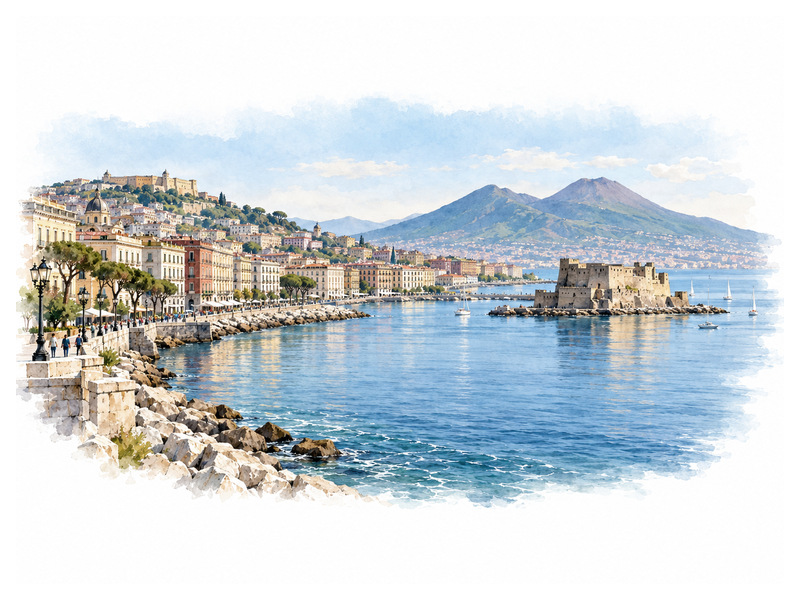
Naples does not offer a distant or carefully staged beauty. It surrounds the traveller immediately: voices moving through narrow streets, laundry above ancient stone, church domes appearing between buildings and the blue of the bay opening unexpectedly at the end of an avenue. Mount Vesuvius remains on the horizon, giving the city a dramatic sense of place that belongs to nowhere else in Europe.
For centuries, Naples has absorbed Greek, Roman, Spanish, French and Bourbon influences while preserving an identity entirely its own. Archaeology, opera, contemporary art, food and everyday theatre exist side by side. The historic centre is dense and energetic; Chiaia is polished and fashionable; Posillipo offers villas and extraordinary views; while the Lungomare creates a more spacious relationship with the sea.
Renting a luxury car in Naples is most valuable when the city becomes the gateway to Campania. The oldest neighbourhoods are better explored on foot, and several central areas are controlled by separate limited-traffic zones. Once outside the historic core, however, a private vehicle creates access to an exceptional collection of destinations: Pompeii, Herculaneum, Mount Vesuvius, the Royal Palace of Caserta, Sorrento, the Amalfi Coast and Paestum.
Exinoir can arrange delivery at Naples International Airport, selected hotels, private residences, marinas and other agreed locations. Guests staying in the historic centre should confirm the correct ZTL procedure before arrival. For waterfront hotels in Chiaia or Santa Lucia, valet parking or a supervised garage is usually more convenient than searching for street parking with a valuable vehicle.
The Bay of Naples also makes the city a natural meeting point between road and sea. Ferries and private transfers depart for Capri, Ischia and Procida, while Molo Beverello and other port areas connect the centre with the islands. A practical itinerary may involve collecting the car after an island stay or returning it before boarding, rather than paying to keep it parked while it is not being used.
Pompeii and Herculaneum are among the most significant archaeological sites in the world and can be reached from Naples for a half-day or full-day visit. Arriving early helps avoid the busiest periods and summer heat. Mount Vesuvius can be incorporated into the same wider itinerary, but access, tickets and parking arrangements should be verified in advance because visitor procedures can change.
Sorrento is a natural next stage for travellers seeking coastal scenery, refined hotels and access to Capri. The road becomes increasingly demanding as traffic grows and the coastline narrows. A chauffeur can be the more relaxing choice during high season, allowing guests to enjoy the view without managing congestion, parking and local restrictions.
The Amalfi Coast deserves time rather than speed. Positano, Amalfi and Ravello are unforgettable, but their roads are narrow, parking is limited and seasonal traffic controls may apply. A large SUV or very low supercar can be more impressive than practical here. Depending on the season, the best solution may be a moderately sized cabriolet, a chauffeur-driven saloon or a vehicle delivered directly to a hotel with confirmed parking.
In the opposite direction, Caserta offers a more open and formal excursion centred on the Royal Palace and its gardens. South of Naples, Paestum combines ancient Greek temples with the gastronomic traditions of the Cilento area. These longer and less constrained routes give grand tourers and performance cars a more appropriate environment than the streets of the historic centre.
Spring and autumn are ideal for a luxury road trip from Naples. The coast remains luminous, temperatures suit open-roof driving and traffic is generally more manageable than in August. Summer brings the strongest seaside atmosphere but requires reservations, additional transfer time and careful parking plans. Winter reveals a more local city and works particularly well for culture, gastronomy and business travel.
A
luxury car rental in Italy can connect Naples with Rome to the north or Puglia to the east, creating a longer journey through southern Italy. Whether the plan involves a romantic coastal escape, a family villa, a yacht departure or several days devoted to archaeology, the right vehicle should respond to the route rather than simply attracting attention. Naples already provides all the theatre a journey could need.
~
What to see in Naples and around
Begin in the historic centre, where Spaccanapoli appears to divide the old city in a near-straight line. Churches, courtyards, cafés, workshops and residential life overlap within a remarkably concentrated area. Via San Gregorio Armeno is famous for its artisan nativity workshops, while the Monastery of Santa Chiara offers a calmer contrast through its decorated cloister.
The Sansevero Chapel contains the Veiled Christ, one of Naples’ most admired works of sculpture. Entry is controlled and reservations are strongly recommended. Nearby, the Cathedral of Naples is connected with the devotion to San Gennaro and introduces another layer of the city’s religious and cultural identity.
The National Archaeological Museum of Naples is essential for understanding Pompeii, Herculaneum and the ancient world of Campania. Its collections give context to the sites outside the city and deserve several hours rather than a rushed visit. Combining the museum with Pompeii on the same day is possible but demanding; separating them usually produces a richer experience.
Move towards Piazza del Plebiscito for a more monumental Naples. Palazzo Reale, the Basilica of San Francesco di Paola, Galleria Umberto I and Teatro di San Carlo form an elegant sequence near Via Toledo. This area works well for a chauffeur drop-off followed by a walking itinerary through the centre.
Along the waterfront, Castel dell’Ovo and Borgo Marinari create one of the city’s most romantic settings. Continue through Santa Lucia and the Lungomare towards Chiaia, where boutiques, restaurants and historic residences introduce a more refined urban atmosphere. Villa Comunale and the streets around Via dei Mille are particularly suitable for an afternoon combining shopping and dining.
For the finest panoramas, travel towards Posillipo or take the funicular towards Vomero. Castel Sant’Elmo and the Certosa di San Martino overlook the city, the bay and Vesuvius from above. Posillipo offers a different angle across the water, with villas and winding roads that reveal why the Neapolitan landscape has inspired artists and travellers for centuries.
Outside Naples, Pompeii should be treated as more than a photographic stop. Comfortable shoes, water and sufficient time are essential. Herculaneum is smaller but extraordinarily preserved, making it an excellent alternative or companion visit. The Royal Palace of Caserta suits architecture and garden lovers, while Paestum rewards a longer journey south.
The islands should not be overlooked simply because the page concerns car rental. Capri, Ischia and Procida belong to the Naples experience, but a car is often best left in secure parking or returned before departure. Exinoir can help coordinate the road portion around a yacht, ferry or island stay, allowing the itinerary to change naturally from driving to the sea.
~
Driving in Naples: Parking, ZTL and Local Tips
Driving in Naples can be rewarding outside the historic core, but central traffic requires confidence and advance planning. The city has multiple ZTLs rather than one universal restricted area, and each may follow its own gates, hours and permit rules. Navigation applications should never replace the signs displayed at the entrance to a controlled street.
Does Naples have a ZTL?
Yes. Naples has several limited-traffic and pedestrian areas, including the Centro Antico, Tarsia–Pignasecca–Dante, Chiaia, Morelli–Filangieri–Mille and other local zones. Restrictions differ according to the area, day and season. Check the exact route and official municipal information before driving towards a central hotel, restaurant or garage.
How does the Centro Antico ZTL operate?
The Centro Antico is monitored by multiple electronic gates. Published schedules vary by gate: Via Miroballo, Via Duomo and Via Santa Sofia have historically operated on different hours from Via del Sole, which also has later restrictions on weekends and holidays. Because individual arrangements can be updated, verify the live signs and current municipal page before entry.
Can I drive to a hotel inside a restricted zone?
Do not assume that a hotel reservation automatically authorises access. Contact the property before arrival, provide the registration plate and request the precise permitted route and parking procedure. If the hotel uses a partner garage, confirm which facility is responsible for registering or authorising the vehicle.
Where should I park a luxury car in Naples?
Use a supervised hotel garage, reputable private facility or pre-arranged valet service. Street parking can be difficult in central districts and is not the preferred option for an exotic or high-value car. Check garage width, vehicle-height limits, ramp angle and opening hours before arriving with a low sports car or large SUV.
Are there park-and-ride options?
ANM manages several interchange and structured car parks, including facilities connected with public transport. Brin and Colli Aminei are among the recognised options, although they serve different approaches to the city. Their suitability depends on the itinerary and vehicle, so confirm current opening hours and security services before use.
What should I know when collecting a car at Naples Airport?
Naples Airport has a controlled traffic area where vehicles may remain in the access zone for a limited time. The airport currently indicates a maximum transit period of 15 minutes before the vehicle must leave or enter an authorised parking area. Coordinate the meeting point and flight arrival carefully to avoid unnecessary circulation.
Is it practical to drive to Pompeii and Herculaneum?
Yes. Both sites can be reached by car, making it easier to continue towards Vesuvius, Sorrento or another destination afterwards. Use an official or reputable car park, remove visible luggage from the cabin and avoid leaving valuable belongings in the vehicle.
Should I drive the Amalfi Coast myself?
Experienced drivers may enjoy the route outside the busiest periods, but summer traffic, narrow roads, buses, scooters and limited parking can make the journey tiring. Seasonal traffic measures may also apply. A chauffeur-driven car or hotel-to-hotel transfer is often the more luxurious solution during high season.
Is a supercar suitable for Naples?
A supercar is better suited to selected journeys outside the historic centre than to daily movement through narrow streets. Low ground clearance, steep garage ramps, pavé and dense traffic require caution. Wider routes towards Caserta, Paestum or Rome provide a more appropriate setting, always within legal and safe driving limits.
Which scenic drives begin in Naples?
Posillipo offers a short panoramic route within the city. For a full day, travel towards Pompeii and Sorrento, the Royal Palace of Caserta or Paestum. The Amalfi Coast requires the most preparation, while routes north towards Rome or east towards Puglia are better suited to comfortable grand tourers.
Can Exinoir deliver to the airport, port or hotel?
Delivery and collection may be arranged at Naples Airport, selected hotels, private residences, marinas and agreed port-area meeting points. Vehicle access immediately beside ferry terminals can be restricted or congested, so the final location should be coordinated according to the vessel, luggage and departure time.
~
Choosing the Right Luxury Car for Naples
Naples calls for a more selective approach than many European destinations. The most expensive or powerful car is not automatically the most suitable. Historic streets, coastal roads, ferry connections and regional excursions each require a different solution.
For a stay centred on Chiaia, Santa Lucia, Via Toledo and the historic centre, a chauffeur-driven Mercedes-Benz S-Class is the strongest recommendation. It allows guests to move between the airport, waterfront hotels, boutiques, Teatro di San Carlo and the port without personally managing ZTL gates, central traffic or parking. It is especially appropriate for business visits, formal evenings and cruise or yacht connections.
For a romantic journey towards Sorrento during spring or early autumn, a Porsche 911 Cabriolet offers the right balance of emotion and manageable dimensions. It is compact enough for a sports car, refined over longer distances and ideal for open-air views across the bay. Luggage should remain light, and secure hotel parking should be confirmed before departure.
The Amalfi Coast requires greater restraint. A very wide supercar or full-size SUV may become inconvenient on narrow roads and in compact garages. A smaller cabriolet, a Porsche 911 or a chauffeur-driven luxury saloon will usually provide a more enjoyable experience. During July and August, the chauffeur option may offer more genuine luxury than any particular model because it removes the pressure of traffic and parking.
For families arriving with several suitcases or staying in a villa, a Range Rover Sport is more appropriate than a low exotic car. It provides luggage capacity, passenger comfort and a useful driving position for regional touring. Its dimensions still need to be considered around Positano, Amalfi and older parking structures, so the route should be checked before choosing the largest available SUV.
For longer journeys from Naples to Rome, Puglia or southern Italy, a grand tourer becomes the ideal companion. A Bentley Continental GT, Ferrari Roma or Aston Martin combines motorway comfort, luggage capacity and emotional presence. These models are better suited to covering distance than repeatedly navigating the most congested quarters of Naples.
Performance cars and supercars make the most sense when the itinerary includes wider roads, private events or carefully planned excursions towards Caserta and Paestum. A Ferrari, Lamborghini or McLaren can transform a special occasion, but using one primarily between the old town and a central garage offers little of what the car was designed to provide.
Season changes the recommendation. Spring and autumn favour convertibles and sports cars. High summer increases the value of air-conditioned chauffeur service and vehicles that are easy to park. Winter favours an executive saloon or grand tourer for cultural weekends, gastronomy and longer journeys through Campania.
The most convincing Naples itinerary may combine different forms of transport: chauffeur service for arrival and the city, a Porsche Cabriolet for Sorrento, and a ferry or yacht for the islands. Exinoir can structure the vehicle around the route rather than forcing the entire holiday into one automotive category. In Naples, intelligent planning is the highest expression of luxury.
~